In the HTML report the “Technical Explanation“ is Operator groups (Account Operators, Server Operators, ...) can take indirect control of the domain
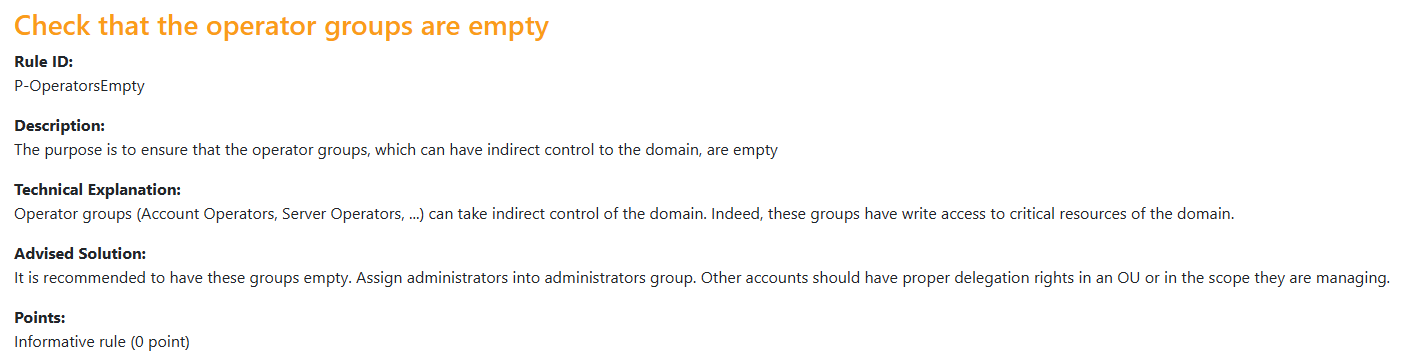
Does the “…” mean the rule includes more? No, it does not:
- The Rule is only for
Server OperatorsandAccount Operators:
pingcastle/PingCastle/Healthcheck/Rules/HeatlcheckRulePrivilegedOperatorsEmpty.cs at b43dcee39bb17a7c5443b6509a5601ea54adedd0 · netwrix/pingcastle · GitHub - This is “on purpose” and
The other groups (backup operators, print operators, ...) are the subject of different rulesbut confuses me everytime:
P-OperatorsEmpty only 2 of 5 operators groups · Issue #141 · netwrix/pingcastle · GitHub
So I was trying to name the “other groups” also called “…” (Found them here) and find the different rules :
- “S-1-5-32-548” - Account Operators - P-OperatorsEmpty / P-RODCNeverReveal /P-DsHeuristicsAdminSDExMask
- “S-1-5-32-549” - Server Operators - P-OperatorsEmpty / P-RODCNeverReveal / P-DsHeuristicsAdminSDExMask
- “S-1-5-32-550” - Print Operators - P-DsHeuristicsAdminSDExMask
- “S-1-5-32-551” - Backup Operators - P-RODCNeverReveal
- “S-1-5-32-569” - “Certificate Operators” - ?none?
Lets have a look at “Certificate Operators“:
The “Certificate Operators” is named “DOMAIN_ALIAS_RID_CRYPTO_OPERATORS“ or “cryptography operators“ or “Cryptographic Operators” (also here) by Microsoft and according to the PingCastle sourcecode have the same “CompromiseGraphDataObjectRisk.Medium“ as the group “Backup Operators“.
Microsoft describes this group:
Members of this group are authorized to perform cryptographic operations. This security group configures Windows Firewall for IPsec in Common Criteria mode. This group can’t be renamed, deleted, or removed.
Source: Active Directory Security Groups | Microsoft Learn
…and:
Default Container, Group Scope and Type: Built-in container, Domain-local security group
Description and Default User Rights: Members are authorized to perform cryptographic operations.
Direct user rights: None
Inherited user rights:
- Access this computer from the network
- Add workstations to domain
- Bypass traverse checking
- Increase a process working set
Source: Active Directory Privileged Accounts and Groups Guide | Microsoft Learn
Did you notice? “Certificate Operators“ should be called “Cryptographic Operators” not “Certificate Operators”
So the situation in PingCastle is:
- “Account Operators” and “Server Operators” are validated if in use (Member > 0)
- “Account Operators”, “Server Operators” and “Backup Operators” should not replicate to RODCs
- “Account Operators”, “Server Operators”, “Print Operators” and “Backup Operators” should be protected by SDPROP/AdminSDHolder
- “Print Operators”, “Backup Operators” and “Certificate Operators” can be used (Member > 0) although they are medium/high/medium “ObjectRisk”
- “Certificate Operators” is wrong named medium critical but has no rule reporting it
So, anyone else confused?
What I do with that current situation:
- I have notes for myself when using PingCastle
- I check other operators groups as well and ask customers if they know what they are doing
